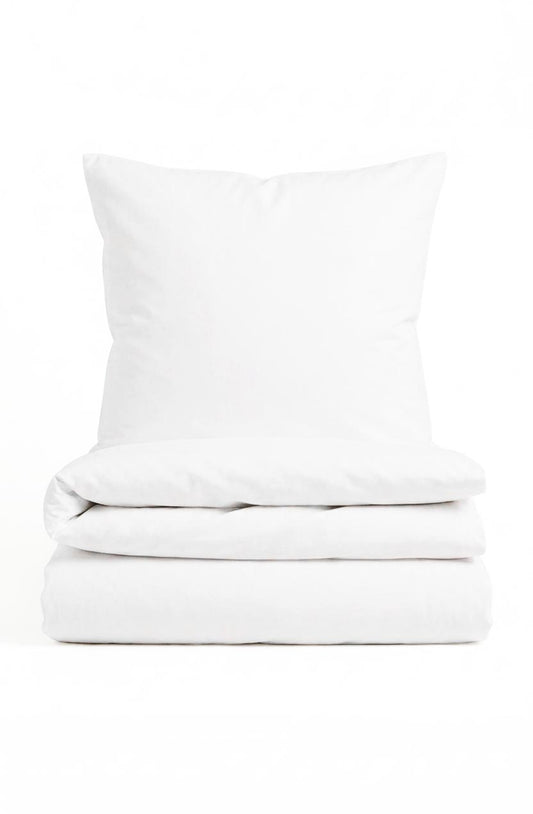
Dust mites feel most comfortable in a very specific climate: warm and damp, as it becomes when we sweat at night and the moisture remains in the bed. Anyone looking for bedding against dust mites will therefore quickly find themselves asking how well a material absorbs and releases moisture. TENCEL bedding by biberna addresses exactly this: The fiber regulates moisture so effectively that dust mites are deprived of the conditions they need to survive. In this article, we explain how TENCEL's moisture management works, why it is particularly interesting for allergy sufferers, and what you should consider when caring for and purchasing it.
Why moisture makes the difference with dust mites
Dust mites feed on human skin scales that accumulate in bedding, pillows, and mattresses. However, they can only reproduce in large numbers if there is sufficient humidity. A bed that remains damp at night and does not dry properly during the day provides them with ideal conditions—regardless of how often you ventilate or vacuum. Even regular vacuuming and ventilation will achieve little if the bedding itself does not release moisture quickly enough. That is exactly why many guides, including our article on fighting dust mites in bed, identify a dry bed environment as the most important factor. If you are also struggling with symptoms, you can find an overview in our article on dust mite allergy: symptoms and triggers.
TENCEL against dust mites: the fiber's moisture management
biberna was the first manufacturer to offer bedding made from Lenzing's TENCEL fiber, and therefore knows the fiber's properties particularly well. TENCEL absorbs moisture very quickly and releases it just as quickly, so the surface of the bedding remains noticeably drier than with many other materials. This is exactly what matters when it comes to TENCEL and dust mites: Where it remains dry, dust mites lack the moisture they need to survive and reproduce. TENCEL thus naturally deprives them of their means of survival, without any chemical additives, sprays, or special equipment. The principle works night after night, simply through the properties of the fiber itself, without you having to do anything extra. You can find more about the differences between materials in our article TENCEL vs. cotton.
A fiber for the whole year
Another advantage: TENCEL bedding is suitable for year-round use. The moisture-regulating principle works just as well in summer as in winter, so you do not have to switch between summer and winter bedding to benefit from the fiber's properties. This is particularly important for households with allergies, where a dry, balanced bed environment is important all year round: one cover, one principle, all year round—without seasonal changes and without compromising on sleep comfort.
Caring for TENCEL properly: wash at 40 °C
For the moisture management to work effectively over time, proper care is also essential. biberna TENCEL bedding can be washed at 40 °C—a temperature that is gentle on the fiber while still being sufficient to keep bedding hygienically clean. A regular washing routine is particularly important for dust mite allergies, as it reliably removes skin scales and mite excrement. If you want to enhance the protection, TENCEL bedding can be sensibly combined with a suitable mattress protector. We have summarized the most important points on this in our guide mattress protectors for dust mite allergies—together, moisture management and a mattress protector create a cohesive overall concept for a low-mite bed.
Who TENCEL is particularly suitable for
TENCEL bedding is especially interesting for anyone who values a dry, pleasant bed environment without having to compromise on softness and comfort. As biberna is a family-owned company that sells without intermediaries, you get TENCEL bedding at a very good price-performance ratio—directly from the manufacturer and, like all biberna products within Germany. You can find an overview of our current TENCEL range in the TENCEL bedding collection, with additional qualities for every need in the main bedding category.
Frequently asked questions
Does TENCEL bedding kill dust mites?
No, TENCEL does not actively kill mites. However, the fiber regulates the moisture in the bed so effectively that dust mites are deprived of the conditions they need to reproduce—a purely physical principle without chemical additives.
At what temperature should I wash TENCEL bedding?
biberna TENCEL bedding can be washed at 40 °C. This temperature cleans thoroughly, removes skin scales and mite residue, and is gentle on the fiber.
Is TENCEL also suitable for winter?
Yes, TENCEL is suitable for year-round use. The moisture-regulating principle works regardless of the season, so you do not have to switch between different types of bedding.