If you are allergic to house dust mites, you hear the same advice again and again: “Wash your bedding at 60 degrees.” But is that really true – and what happens at 40 or 30 degrees? In this guide, you will find out at what temperature you actually kill house dust mites, why rinsing out the allergens is at least as important, and which bedding qualities can withstand the necessary washing without being permanently damaged.
At what temperature do house dust mites die?
House dust mites are surprisingly resilient, but they stand no chance against heat and dryness. As a rule of thumb: House dust mites reliably die at around 60 °C. Washing at 60 °C for a normal cycle practically kills all the mites in the bedding.
At 40 °C, things look different: Some of the mites survive this temperature, while others are simply rinsed away with the water. So a 40-degree wash is not completely ineffective – but if you want to specifically kill mites, it is the weaker option. At 30 °C, the mechanical effect is mainly what works: dirt, skin flakes, and some of the allergens are removed with the wash water, but the mite population itself remains largely intact.
Important to know: It is not the mite itself that triggers the allergy, but proteins in its faeces. These allergens are water-soluble and are rinsed out during washing – regardless of the temperature. That is why regular washing helps even if you have to wash at 40 °C once in a while. You can read more about the background in our guide Recognizing a mite allergy: Symptoms & triggers.
Temperature, effect and material compared
The short answer is 60 °C. However, which temperature is right for your bed depends on what is in the wardrobe: Not every quality can withstand a hot wash, and not every situation requires one. The table shows what you actually achieve at which temperature.
| Washing temperature |
Effect on mites |
Effect on allergens |
Ideal for |
| 60 °C |
Mites reliably die |
Allergens are rinsed out |
Severe house dust mite allergy; pure cotton qualities such as Flannel, Renforcé, Linon |
| 40 °C |
Some survive, some are rinsed out |
Allergens are rinsed out |
Sensitive qualities and TENCEL; wash more frequently instead |
| 30 °C |
Population remains largely intact |
Some allergens are removed |
Synthetic fibres and furnishings that do not allow more; no allergy programme |
| Tumble dryer (after washing) |
Dry heat puts mites under great stress |
No additional effect |
Flannel and Melange-Flanell – become even fluffier |
The consequence: If you cannot wash at 60 °C, you are not lost – you just have to wash more frequently. If you wash hot every week, however, you need a quality that can withstand this for years.
Why a hot wash alone is not enough
60 degrees work – but only where you can also wash. Mites do not only live in the bedspread, but above all in the mattress, the pillow, and the duvet. A sensible approach therefore combines several elements:
-
Wash bedding every one to two weeks at 60 °C – more likely weekly in the case of an acute allergy.
-
Wash pillows and duvets with it, provided the care label allows it, usually every three to six months.
-
Protect the mattress: A washable mattress protector absorbs moisture and skin flakes before they reach the mattress. We explain why this makes such a big difference under Mattress protection: Benefits for hygienic sleep.
-
Ventilate while dry: Mites need air humidity. Fluff the bed in the morning instead of smoothing it out immediately, and ventilate the bedroom daily.
A powder laundry detergent additionally supports the effect because it contains the bleaching component that liquid detergents do not. You should omit fabric softener – it coats the fibre and reduces absorbency.
Which bedding can withstand a 60-degree wash permanently?
Frequent washing at a high temperature is stressful for any textile. This is exactly where the difference between original quality and cheap goods shows. Pure cotton qualities in original quality from the manufacturer are made for this kind of stress:
Flannel made from 100% cotton with 160 g/m² is the classic for allergy-friendly beds: strong, wash-resistant, and still fluffy even after many washes. We once developed the Flannel quality ourselves – and continue to produce it in Germany to this day.
Renforcé is the easy-care all-rounder for all seasons: smooth, densely woven cotton fabric, uncomplicated in the wash and quickly ready to use again – ideal if you need several sets to alternate.
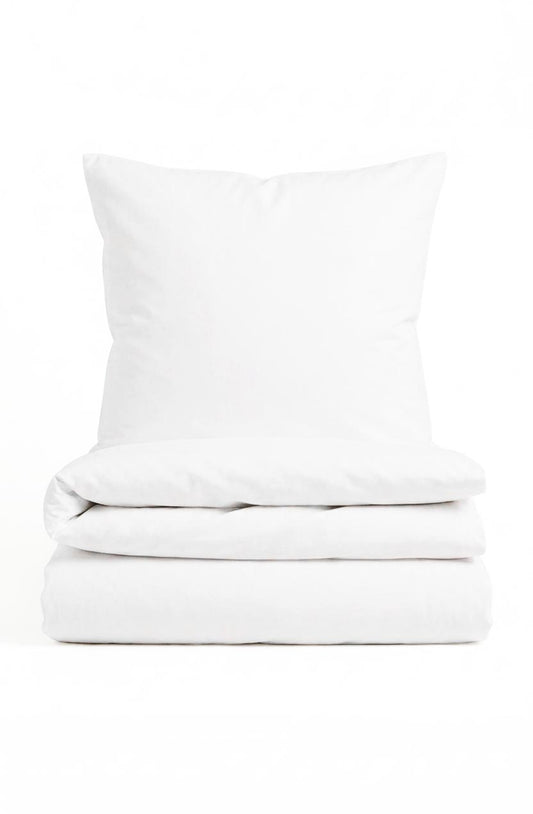
TENCEL takes an additional step: The fibre absorbs moisture particularly well and releases it again. A drier bed climate deprives mites and bacteria of their basis for life – and the quality is very easy to clean even at 40 °C. A concrete example is the biberna TENCEL bedding in white, Art. 0474494 – €49.95 in 135 × 200 cm. biberna was the first manufacturer of TENCEL bedding ever.
You can find an overview of all qualities in our bedding collection; specially selected qualities for sensitive sleepers are shown in our allergy bedding. If you are unsure which temperature is right for which material, the article Washing bedding – 30, 40 or 60 degrees? will help.
What to do if 60 degrees are not possible?
Some materials – such as synthetic fibres or sensitive furnishings – cannot withstand 60 °C. Then the rule applies: wash at the highest permitted temperature and therefore more frequently. Rinsing out the allergens remains effective. The tumble dryer additionally helps: The dry heat in the dryer puts mites under great stress, provided the care label allows drying. Flannel and Melange-Flanell become particularly fluffy in the dryer.
The often recommended method of using the freezer only works to a limited extent: Cold does kill mites, but the allergens remain completely in the textile. Without subsequent washing, this does little for allergy sufferers.
Frequently asked questions
Are 40 degrees really not enough to kill mites?
Not for sure killing. Some of the mites survive 40 °C. However, allergens are also rinsed out at 40 °C – if you cannot wash hotter, you should wash more frequently instead.
How often should I as an allergy sufferer change the bedding?
Weekly is the recommendation for a severe house dust mite allergy. Without an allergy, two weeks are sufficient. This is practically achieved with several sets to alternate.
Does bedding get damaged by frequent washing at 60 degrees?
High-quality cotton qualities are designed for this and lose neither shape nor feel. What matters are yarn quality and workmanship – in contrast, cheap, thin goods quickly show pilling and washed-out colours.
Which temperature is right if I have no allergy at all?
Then 40 °C with colour detergent in the normal two-week rhythm are sufficient. 60 °C are useful above all for white laundry, in the case of an allergy, and after an illness.