
Bedding for the transitional season: late summer to autumn
Matching products from the guide
-
-
biberna Mako Sateen Pillowcase 40x80 cm (0615211)
Regular price $19.95Regular price -
biberna Tencel Bedding – Dove Blue (0474520)
Regular price From $89.95Regular price -
biberna Mako Sateen Pillowcase 40x80 cm (0615211)
Regular price From $109.95Regular price
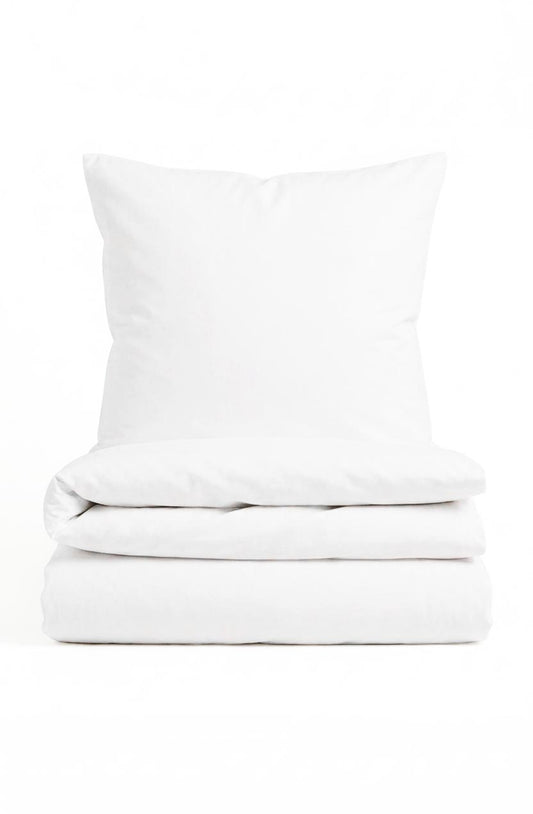


There are weeks of the year when the bed never feels quite right. At noon, the thermometer still shows 24 degrees, but by five in the morning, it’s down to 11. Those who fall asleep under the summer duvet wake up chilled in the middle of the night – those who have already switched to flannel wake up at midnight, sweating on top of the covers. That is exactly why you need the right bedding for the transitional season: a cover that retains warmth without blocking moisture.
At biberna, we have been manufacturing in Germany since 1932 and know this transitional phase from countless customer conversations. The good news: you don’t need a third complete set. You need the right quality.
Why late summer makes the bed so restless
Your body lowers its core temperature by about one degree at night. At the same time, depending on the person, it releases 200 to 500 milliliters of moisture into the environment. In the height of summer, heat release is the main issue; in winter, it is retaining warmth. During the transitional season, both tasks fall on the same night: in the first half of the night, the bedroom is still heated by the daytime warmth, but by morning, it cools down noticeably.
Bedding that only masters one of these two tasks will inevitably become uncomfortable once a night. What is needed, therefore, is a material with good moisture management and moderate warmth – not the warmest and not the coolest in the closet.
The right qualities for the transitional season
Renforcé – the easy-going all-rounder
Renforcé is a smooth-woven cotton fabric in a plain weave: lightweight, breathable, and gentle on the skin. It does not actively warm, but it also does not block anything. If you tend to feel too warm rather than too cold at night and prefer to take a thicker blanket if in doubt, renforcé bedding is the simplest answer to late summer. It is also easy to care for and dries quickly.
TENCEL – the moisture management expert
We were the first manufacturer to develop bedding with the TENCEL brand fiber from Lenzing – and it is precisely during the transitional season that this fiber shows its strength. It absorbs moisture very well and releases it again, rather than leaving it on the skin. The result: you stay comfortably cool during the warm first half of the night and do not wake up in damp bedding. TENCEL bedding is a true all-year-round quality and is very easy to care for at 40 °C.
Seersucker – as long as the nights are still mild
As long as the nights rarely drop below 15 degrees, there is no need to put away the summer bedding just yet. The crinkled structure of seersucker keeps the fabric away from the skin and ensures air circulation – a built-in air conditioner. A practical side effect for the changeable season: seersucker is 100% non-iron; simply hanging it up is enough.
Melange flannel – when it gets cool early
If you get cold quickly, mélange flannel is a gentler introduction to the cold season than flannel. This quality was developed by us and is produced entirely in Germany: fluffy and soft, yet made from 100% cotton. Mélange flannel provides noticeable warmth but feels less heavy than classic flannel – ideal for October nights when the heating is still off.
When is the right time to switch to flannel?
The most reliable rule of thumb does not come from the calendar, but from the bedroom: switch when the room temperature consistently drops below 18 degrees at night. In most households, this happens between mid and late October. Our flannel has a very high loft at 160 g/m² – if you put it on too early, you will sweat.
A proven intermediate step: separate the duvet cover and the fitted sheet. A fitted sheet made of flannel or fine jersey warms from below, while the cover remains lighter. Most heat is lost from below, which is why this trick works surprisingly well.
And no matter which quality you choose: wash new bedding before using it for the first time, and use our 7 expert tips for washing and caring as a guide. For sizing, our guide Bedding sizes explained will help you. You can find the entire selection in our bedding overview.
Three simple steps that help immediately
Ventilate briefly in the morning. Opening the window wide for five to ten minutes carries the moisture from the night out of the room – the foundation for a good sleep environment in the evening.
Check the duvet before putting on the cover. Often, the problem is not the cover, but a duvet that is too warm. Adjust the duvet first, then the bedding.
Keep two sets close at hand. During the transitional season, the weather changes faster than the laundry cycle. Keeping a light set and a warmer set in the closet will save you restless nights.
Frequently asked questions
Which bedding is best suited for the transitional season?
Renforcé and TENCEL are the most reliable all-rounders: light enough for mild evenings, but not cooling. Those who get cold quickly will be better off with mélange flannel.
When should I switch to flannel bedding?
As soon as the bedroom temperature consistently drops below about 18 degrees at night – usually from mid-October onwards. Before then, flannel at 160 g/m² feels too warm for many people.
Do I need a separate set for the transitional season?
Not necessarily. If you have a light summer set and a warm winter set, the light one is usually sufficient – combined with a warmer duvet or a flannel fitted sheet.